

Editor’s Note: This series draws on analysis the National Sustainable Agriculture Coalition (NSAC) conducted in partnership with Bernie Kluger, Managing Partner at Prospect Partners, LLC.
Bernie has led strategic realignments, crisis recoveries, and major capacity-building initiatives in government, higher education, and the private sector. Prior to joining Prospect Partners, Bernie served as enterprise lead for organizational effectiveness and workforce development at the US Department of Agriculture (USDA). At USDA, Bernie tackled complex multi-stakeholder negotiations that delivered results for the public, including a nationwide hiring surge that powered a $40 billion expansion in operational capacity. Bernie holds a B.S. in Political Economy from Williams College and an M.B.A. from Columbia University. He lives in Washington, DC.
This blog post is the second in a series updating analysis on the widespread staffing crisis across the United States Department of Agriculture (USDA), focusing on the Natural Resources Conservation Service. While our previous post showed that every USDA agency lost staff during 2025, staff losses in direct farmer- and rancher-serving offices are particularly concerning as America’s farmers grapple with severe and ongoing economic and weather disruptions.
Staff in the Natural Resources Conservation Service (NRCS) work directly with farmers, providing technical assistance, financial support, and guidance to navigate the suite of programs offered by the agency. Losses in these direct farmer-serving agencies mean that US farmers, ranchers, and landowners have fewer experts in their communities to turn to for assistance. The National Sustainable Agriculture Coalition (NSAC) urges Congress to prioritize restoring NRCS field staff capacity, as farmers facing increasingly unpredictable weather impacts cannot afford to lose the local conservation expertise they depend on to build environmentally and economically resilient operations.
Conservation Staff Depleted
NRCS lost 23% of its staff between January 2025 and January 2026. NRCS staff work directly with farmers and landowners to identify conservation practices that are well-suited to their needs and local natural resource concerns. They provide vital technical assistance for farmers and landowners and help them apply for and manage contracts with conservation programs that help share the cost of conservation practices.
The NRCS staff position that experienced the largest losses was Soil Conservationist, with a loss of 711 Soil Conservationists during the time period and an additional 283 Soil Conservation Technicians. Soil Conservationists are the primary field staff who work directly with landowners on conservation planning and implementation, and Technicians provide field-level support for conservation work, often handling site assessments, measurements, and installation oversight alongside Soil Conservationists.
Examining NRCS staff losses at the county level shows more clearly how many US farmers, ranchers, and landowners now lack access to local NRCS staff in their counties. In January 2025, 2,386 counties across the US had NRCS staff working in their local county office. By January 2026, 141 of those counties had lost 100% of their NRCS staff. This means that farmers and landowners in those counties lost staff with local relationships and local knowledge, and that the remaining NRCS staff are now stretched thin over larger geographic areas.
The map below shows the NRCS staffing levels for every county and the change from January 2025 to January 2026, using data from the Office of Personnel Management.
Figure 1: County-Level NRCS Staffing Losses (Jan 2025-Jan 2026)

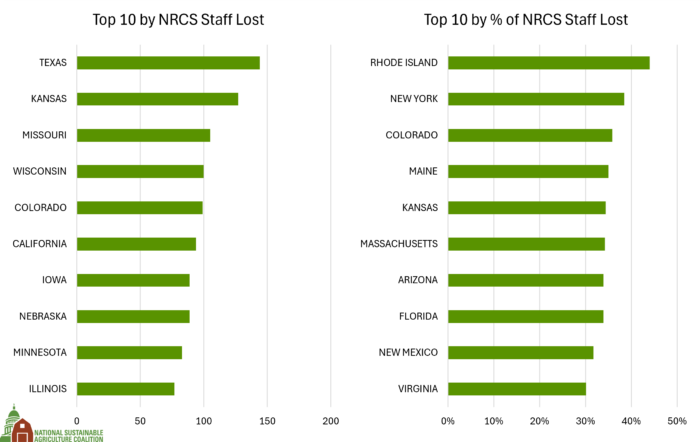
Major agricultural states in the Midwest and West lost the most NRCS staff during 2025. The largest staffing losses were in Texas (144), Kansas (127), Missouri (105), Wisconsin (100), and Colorado (99). States with smaller starting NRCS staff saw deeper percentage declines, with the largest in Rhode Island (44%), New York (38%), Colorado (36%), and Maine (35%). Kansas, Massachusetts, Arizona, and Florida all lost 34% of their NRCS staff.
Figure 2: Top 10 States with NRCS Staff Losses (Jan 2025-Jan 2026)
Loss of Key Conservation Positions
The picture sharpens further when looking specifically at five specific occupations most central to NRCS’s conservation mission: Soil Conservation, Soil Conservation Technicians, Soil Science, Agronomy, and Rangeland Management. Together, these occupations lost 1,178 employees in 2025, nearly one in five positions. One hundred thirty-nine counties with at least one employee in these key roles in January 2025 had none by January 2026. Kansas lost key conservation staff in 15 counties; Indiana and Texas each lost coverage in 10. Georgia, while not among the top states for total job losses, lost all key conservation staff in 9 counties — a pattern of losses spread thinly across many locations rather than concentrated in larger offices, leaving widespread gaps in local coverage across the state.
Farmers Feel the Impacts of Staffing Loss
The consequences of these staffing losses are already reducing farmer access to conservation programs. According to a recent analysis by NSAC member organization the Institute for Agriculture and Trade Policy (IATP), acceptance rates for the Environmental Quality Incentives Program (EQIP) and Conservation Stewardship Program (CSP) dropped sharply in fiscal year 2025. Only about 24% of EQIP applicants and 37% of CSP applicants were awarded contracts in FY2025 — a steep drop from FY2024, when approximately 43% of EQIP applicants and 54% of CSP applicants received contracts. NRCS staff are essential at every step of that process: they help farmers understand which programs fit their operations, support them through the application, and provide the technical assistance needed to implement and manage contracts. Fewer staff means longer waits, fewer applications processed, and more farmers left without the conservation support they need.
Staff Losses Mean Less Support for Farmers
The loss of nearly a quarter of NRCS staff in a single year, including over 700 Soil Conservationists and Technicians, is not an abstraction. These are the people farmers call when they want to plant a cover crop, design a nutrient management plan, or try to navigate a conservation program contract. Their absence means longer wait times, fewer site visits, and reduced access to the technical assistance that makes conservation programs work. With 141 counties now entirely without local NRCS staff, the support net for America’s farmland has real and growing holes.
Congress must act to restore NRCS staffing capacity before these losses become permanent. Farmers and ranchers across the country are navigating an era of unprecedented natural disasters, from severe drought to catastrophic flooding, and they need the support of local conservation experts who know their land, their operations, and their communities. NSAC urges Congress to prioritize restoring NRCS field staff, with particular attention to rebuilding the positions that form the backbone of conservation delivery. Every county that loses its last NRCS employee loses irreplaceable local knowledge, and the farmers in that county lose a critical partner in building the resilience their operations depend on.