

Editor’s Note: This post is a guest blog authored by Mia Keady, a Postdoctoral Research Associate in the Department of Soil & Environmental Sciences at the University of Wisconsin – Madison and is part of our ongoing series on USDA staffing. Her research focuses on soil health, land stewardship, and conservation incentives. She’s passionate about finding solutions to environmental degradation and understanding soil processes in response to land management. Mia grew up in Lincoln, Nebraska, where she was first introduced to the prairie. Her work spans grassland ecology, microbial ecology, and conservation biology. She completed her bachelor’s in biology at Nebraska Wesleyan, master’s in biology at George Mason University, and Ph.D. in Environment and Resources at the University of Wisconsin-Madison.
‘Conservation requires management’ was a key takeaway from my undergraduate studies; dispelling naive ideas about letting the land heal itself without stewardship. During my academic journey, I’ve learned how humans are a part of nature and have shaped ecosystems for millennia and that contemporary conservation solutions will likewise require human interventions. The last century and a half of tilling up the once rich prairie has depleted soils and created many environmental problems including declining surface and ground water quality, increased flooding, biodiversity loss, and contributing to climate change.
Recognizing this difficult reality, can we reshape the impact of modern agriculture? Can we steward our agricultural lands to protect and enhance ecosystem services? What can we learn from the prairies to inform our stewardship? What strategies advance perennial agriculture that builds soils, retains nutrients, and provides habitat if managed well?
My research addresses these questions by examining soil change in the once-prominent but now threatened prairies of Southern Wisconsin, the influence of federal conservation funding across the state, and the critical role played by staff at the Natural Resources Conservation Service (NRCS) and county conservation districts.
In this post, I will discuss the important role that perennial agricultural systems can play in supporting ecosystems and how perennial practices are supported by conservation staff, using Wisconsin as an example. My research shows that the number of NRCS and county conservation staff corresponds to federal conservation dollars spent in counties and that passionate and highly-skilled conservation staff are essential to supporting the adoption of perennial agricultural systems.
What can agriculture learn from prairies?
Prairies provide key ecosystem benefits like clean ground and surface water, reduced flooding, critical habitat, and soil protection (Zhao et al., 2020). How can we mimic these benefits on farms? Perennial agricultural practices, including managed grazing of pasture, forestry, agroforestry, or grassland restoration, mimic the prairie ecosystem and bring many of these ecosystem services into agricultural systems. Peer-reviewed studies consistently show that perennial agricultural systems build or maintain soil organic matter, reduce nutrient and sediment runoff compared to annual row crops, and provide more resilient agroecosystems under climate stress (Culman et al., 2013; DeHaan et al., 2023; Dietz et al. 2024; Kreitzman et al., 2022; Mosier et al., 2021; Picasso et al. 2022; Soto-Gómez and Pérez-Rodríguez, 2022; Sprunger et al. 2024). Perennial agricultural practices that mimic the prairie ecosystem should be prioritized to maximize the environmental benefits of conservation investments.
Do conservation dollars support ‘prairie-like’ agriculture?
Even though perennial agricultural systems deliver substantial long-term environmental benefits, my research finds that they receive only a small portion of the federal agricultural conservation spending in Wisconsin (Keady, 2025).
The US Department of Agriculture (USDA) administers voluntary, cost-share conservation programs to support farmers implementing conservation and nudge land management towards improved ecosystem services. The Environmental Quality Incentives Program (EQIP), administered by the NRCS, is the largest such federal conservation program in terms of total spending. To participate in EQIP, farmers and land managers work directly with NRCS staff and technical service providers to plan, apply for, and implement a range of approved conservation measures on private lands. In my research, I assessed EQIP spending from fiscal years 2014 through 2024 across Wisconsin to ask: Where do federal conservation dollars flow in Wisconsin and what influences where they go? In particular, I examined how much EQIP spending went to perennial agricultural conservation practices.
In Wisconsin, an average $29.7 million per year in EQIP support flowed to farmers in the 11-year period, with ~20% supporting agriculture that ‘acts like a prairie’ (that is, perennial practices including managed grazing of pasture, forestry, agroforestry, and habitat restoration), while ~60% supported interventions within annual row crop and livestock confinement systems such as cover crops and waste storage facilities (see full report here). The remaining 20% was used for multi-system practices such as heavy use areas, or practices that didn’t fall within these categories including dams and streambank protection. These results beg the question: is this the ‘best’ distribution of these dollars? Should we support interventions into systems well-known for environmental degradation to make them a bit less degrading, or should we invest in practices that help transform farms to perennial agriculture that ‘acts like a prairie’?
The Important Role of Conservation Staff
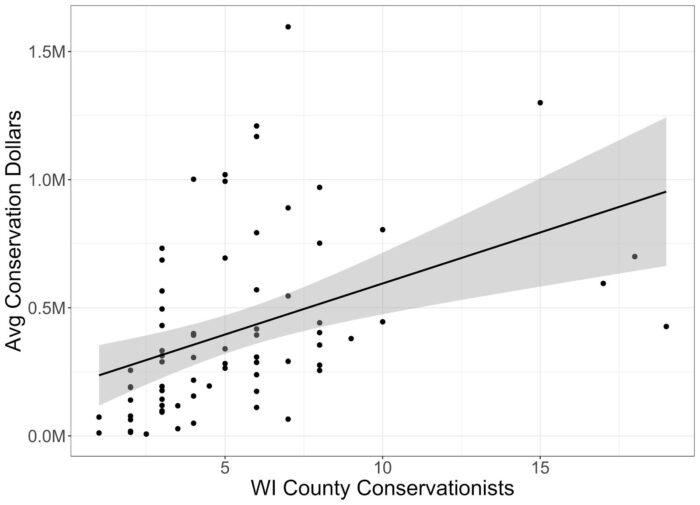
My research explored what county level factors shaped where EQIP dollars flowed. The strongest predictor of where EQIP dollars were spent was the number of conservation staff in a county, both federal and county employees (Figure 1) (Keady 2025). Local and federal conservation staff are critical to helping farmers access support for conservation practices. County conservationists in Wisconsin are members of Wisconsin Land and Water, also referred to as conservation district staff. Federal conservationists are NRCS field staff located within counties. Conservation staff work with farmers to find on-farm solutions and help navigate the application process (with grueling paperwork).Yet, NRCS staff has declined by over 30% over the past two decades, even before the devastating job cuts of 2025. In a time of intense environmental degradation, society desperately needs to support agricultural transitions to perennial systems that maintain soil carbon, produce food, and protect critical ecosystem services. Supporting well-trained and inspired conservation staff is critical to this equation.
Figure 1. NRCS staff (A) and county conservation district staff (B) correlate with the amount of conservation EQIP spending in Wisconsin counties.

How do we transform agroecosystems? Passionate and Skilled Conservation Staff
Transitioning to perennial agroecosystems takes more than increasing conservation staff numbers, it also takes passion. Sauk County conservationist, Serge Koenig spent 30 years working with landowners, and the last 10 years inspiring and supporting transitions to managed rotational grazing. Serge sees grazing as the “most bang for your buck” – a financially viable farming option that provides solutions to environmental issues rather than interventions that slow the problem. His message has been convincing: Sauk County receives the most EQIP dollars in Wisconsin for grazing-related practices (Keady 2025). Serge credits this success to a combination of interpersonal skills, supervisory support, and most importantly – wanting to be the change. The interpersonal skills come naturally to Serge, but he’s adamant these are skills technicians can and should learn. Working with farmers requires “trust, sincere curiosity, and knowing when to listen, when to comment, and when to make suggestions,” he says. Supervisory support that encourages conservation staff to lean-in to their passion and expertise when working with farmers is key. Finally, conservationists want and need access to specialized training in grassland restoration, agroforestry, forestry, silvopasture, and grazing management. The heart of moving the needle towards perennial conservation comes from recognizing the ecological value of a perennial system and making it a priority to advocate for stewardship that makes our world a better place for farmers and society as a whole.
Perennial systems such as well-managed rotational grazing, forestry, and agroforestry can mimic the prairie in protecting and enhancing ecosystem services. Perennial plants protect soil, clean water, and provide habitat – and should be a key tool for conservation programs, including NRCS’s EQIP. Conservation staff are critical to working with landowners and getting conservation on the ground. We desperately need to support their passion and ability to advance land-management and provide benefits to both the farmer, land, and society at large.
Wonderful research. Thank you for sharing.