
The National Sustainable Agriculture Coalition (NSAC) had the privilege of joining many of our members in attending the 41st Annual Farm Aid Festival, held in Virginia Beach, Virginia last month. After a year marked by market instability, a slashed federal workforce, and millions of dollars of cancelled contracts, the circumstances around the 41st Farm Aid had unfortunate parallels to the origins of the festival. We name this not to harp on the negative or point fingers on who to blame, but to express the importance of this work and to highlight that small- to mid-size family farms need collective support now more than ever.
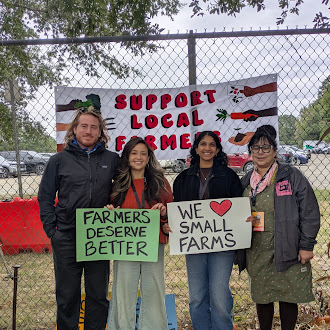
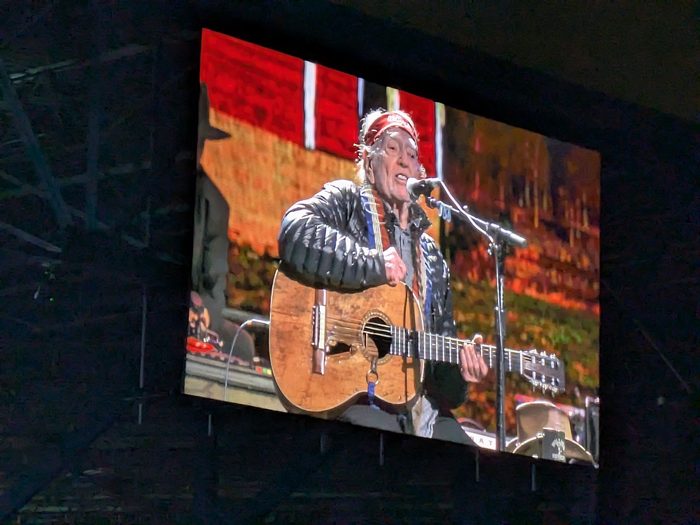
In addition to the well-known music festival featuring artists like Willie Nelson, John Mellencamp, Dave Matthews and the like, on the days leading up to the concert, hundreds of food and agricultural professionals gather to learn from one another. Farm Aid is not just a concert, but it is also a place to build relationships, elevate farmer voices, and connect organizers and food-system practitioners. To recap the experience, this blog post shares some of our learnings, celebrates NSAC’s Virginia based NSAC members, and highlights the organizations that attended Farm Aid this year.
Virginia Food and Farm Landscape
Agriculture is Virginia’s largest private industry, home to close to 40,000 farms, spanning over 7 million acres! The farm tours organized by Farm Aid this year were unique in that one of the tracks offered insights into the marine agriculture industry – an important part of our food system that is underrepresented in most farm bill discussions.
Marine Tour
The Marine tour visited two sites, Tyler’s Beach and Fisherman’s Wharf Marina.
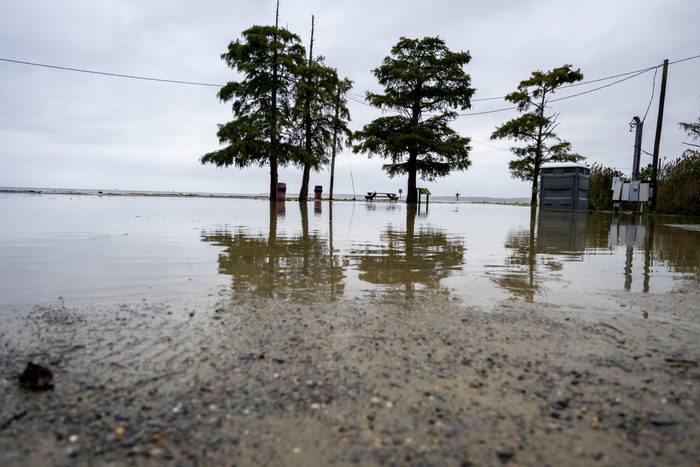
The first stop on the Marine Tour was Tyler’s Beach, along the James River. In the mid twentieth century, there was a thriving waterman’s community, consisting primarily of Black and Native families. A number of factors contributed to the area’s sharp decline in the 1980s: the consolidation of the fishing industry, the Kepone spill in 1975, and overt and covert racism. The group heard from a local crabber, who spoke to the high upfront and maintenance costs of fishing boats and equipment, the lack of support for processing infrastructure, and the complicated (and costly) permitting, which makes it difficult for small-scale fishing operations to turn a profit. In between stops on the tour, the group had the pleasure of eating crabs caught at Tyler’s Beach, as well as local oysters harvested by another nearby water-woman.
The second stop was Fisherman’s Wharf Marina, which spoke to the unique infrastructure and processing needs of watermen. While it is true that all types of food production and distribution require infrastructure along the supply chain to keep food items fresh, clean, and organized – live seafood poses a more urgent challenge. The Wharf offers 75 slips, with included amenities like diesel fueling, electrical equipment, fileting stations, lighting systems, and more. A part of their mission is to provide protected harbor, convenient access to the best fishing grounds on the East Coast, and hassle-free docking for off-shore fishermen, supporting small-scale fisherfolk in the area.
Land Tour
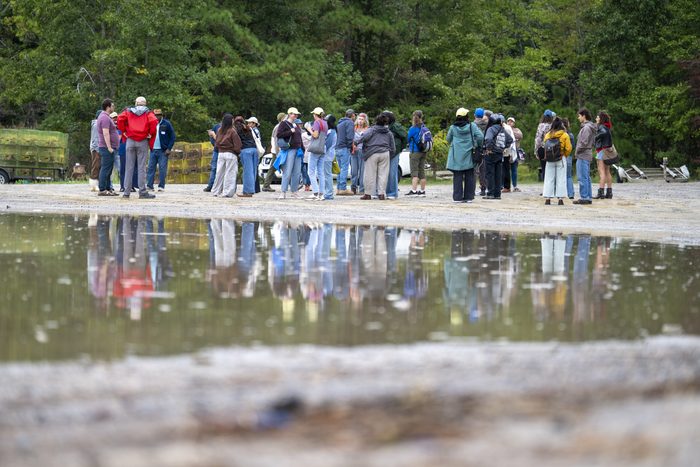
The Land Tour visited three farms, and only managed to get our bus stuck once. The tour visited Creekmore’s Place Farm, Coastal Cattle (and the associated business The Meat Shack), and Cullipher Farm.
These farms range in size and products from small-scale vegetable production at Creekmore’s Place Farm, to larger-scale cattle production at Coastal Cattle, and a mixed livestock-produce and agritourism operation at Cullipher Farm. They also spanned generations, and diverse backgrounds and geographies.
Creekmore’s Place Farm was the newest farm, and the smallest, even though the owners were following in the footsteps of family members who had been selling at the local farmers market for generations from market gardens. Their ownership and continual growth had been supported by local food grants and new farmer grants. This farm sat highest on the coastal ridges, most distant from the ocean, rivers, and potential storm surges.
Coastal Cattle similarly had a generational story dating back to before the founding of the United States, though it also adapted over time, from operating as a large-scale row crop farm to a no antibiotic, pasture raised cattle operation. This was helped by the development of their Meat Shack, which is where they sell straight to consumers after their meat is processed at the nearest plant in North Carolina. The Meat Shack expansion has been made possible by Value Added Producer Grant (VAPG) funding.
Cullipher Farm operates as a low input, highly diversified, largely you-pick and value added operation. It, similarly to the other farms, had a long history of familial production. It also had a history of commodity production, that of tobacco, but after World War Two a relative had helped pivot it into “truck” or direct to consumer vegetable production. Tides, and climate, were on the minds of these farmers, laying closest and lowest to the ocean and surrounding tidal rivers that can swell with strong storms.
Virginia Based NSAC Members
Eastern Food Hub Collaborative
The Eastern Food Hub Collaborative (EFC) is a growing network of 16 local food hubs across the eastern United States. Its vision is to transform an extractive global food system by returning power to local communities, supporting local farmers, investing in environmental stewardship, and providing access to fresh, healthy, local foods for all. The EFC launched in 2019 as a member-led and governed network to support hubs and respond to market opportunities through collaborative market development, hub-to-hub trade, and peer learning. Today, the EFC is a fiscally sponsored project of Locus and is managed and facilitated by Seed Change Strategies.
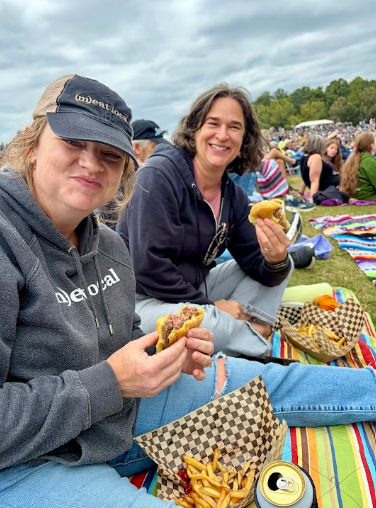
The Seed Change team met Carolina Reid, Farm Aid’s Culinary Director, earlier this year in Spokane, WA, at a planning meeting for a national group of food hub network managers. Carolina was passionate about working with regional food hubs, and the local farms they source from, to provide concessions and catering for the 2026 Farm Aid Festival in Virginia Beach. Working through the EFC, Farm Aid sourced more than $50,000 of local food from a group of EFC members: Firsthand Foods, Freshlist, Working Landscapes, and 4P Foods.
Learn more about EFC and how to support their work here.
Foodshed Capital
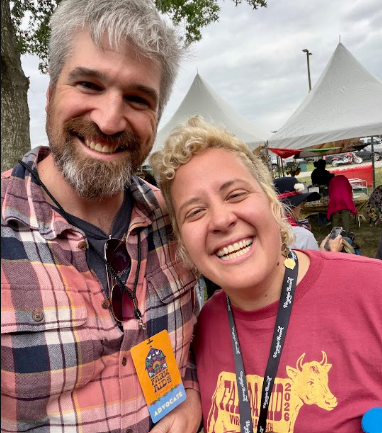
Foodshed Capital is a nonprofit loan fund working to build more regenerative food systems. Recognizing the risks of farming in a changing climate, Foodshed provides flexible, affordable financing and integrated business technical assistance grounded in risk-sharing and deep relationships. Loan terms are tailored to each business, with rigorous underwriting that supports long-term viability while ensuring manageable repayment. With some of the lowest interest rates in the country and no credit scores, fees, or penalties, Foodshed takes an unconventional but effective approach: 99% of loans have been successfully repaid. Learn more about Foodshed Capital and how to support their work here.
Virginia Association for Biological Farming (VABF)
The Virginia Association for Biological Farming is a community of farmers, gardeners, homesteaders, students, researchers, and general supporters of local and sustainable food systems in the state of Virginia. Their mission is to educate about, advocate for, and promote organic and “biological farming” and gardening. They define biological farming as an approach to food and fiber production that respects the natural ecosystem processes in order to yield top quality products, provide a viable living for the producer, and sustain long-term productivity. Learn more about VABF and how to support their work here.
Wallace Center at Winrock
The Wallace Center at Winrock International brings together diverse people and ideas to co-create solutions that build healthy farms, fair economies, and resilient food systems. The Wallace Center partners with rural communities, businesses, and local leaders to develop market-oriented, sustainable solutions at scale that increase food production and profitability, expand market access, conserve natural resources, and build resilient livelihoods. Learn more about the Wallace Center and how to support their work here.
NSAC Members at Farm Aid
Young Farmers
The National Young Farmers Coalition is a farmer-led, grassroots network shifting power and changing policy to equitably resource the new generation of working farmers. As the largest unified voice calling for farm policy that will deliver a bright future for young farmers and ranchers in the US, they are working towards a just future where farming is free of racial violence, accessible to communities, oriented towards environmental well-being, and concerned with health over profit. In support of their mission, Young Farmers just announced the Next Generation Farmer Fund, a new grant program providing $10k-$50k grants to young, regenerative farmers and ranchers across the country. The Next Generation Farmer Fund responds to the need farmers have for capital to make it through the season while also building systems that protect against the worsening systems of climate change. Applications for the fund will be open from October 28 – December 1, 2026.
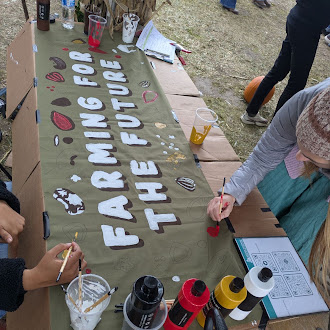
At Farm Aid this year, festival attendees had the opportunity to craft and write a love letter to a young or beginning farmer, which was mailed on their behalf by Young Farmers staff. Learn more about Young Farmers and opportunities to take action here.
Michael Fields Agricultural Institute (MFAI)
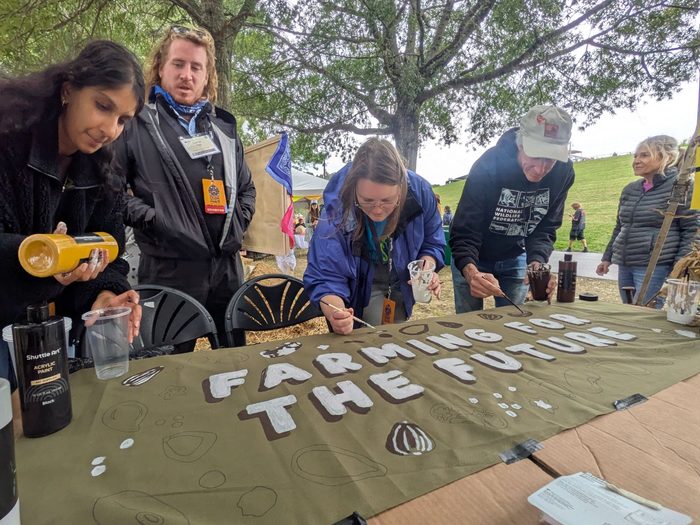
Michael Fields Agricultural Institute’s policy program focuses on empowering farmers and eaters to use democratic processes to direct government resources to advance a regenerative agricultural vision. MFAI catalyzes grassroots and organizational power to cultivate the ecological, social, and economic resilience of food and farming systems. With strategic partners, they facilitate coalitions, convene thinkers, author papers, and organize farmer networks around policy initiatives at both federal and state levels. At Farm Aid this year, MFAI led a ‘paint with food’ activity, where folks had the opportunity to use cut up veggies and acrylic paint to create one of a kind prints. Learn more about MFAI and opportunities to support their work here.
Institute of Agriculture and Trade Policy (IATP)
IATP advocates for a just transition that supports agroecology, pushing for policy reforms internationally at the United Nations and WTO, and nationally in the US farm bill and EU’s Common Agricultural Policy. In Minnesota, they are building model community-based food systems that aim to give all people access to sufficient, culturally appropriate and nutritious food, while providing small- to mid-scale farmers access to new markets. Farmers and food system workers are increasingly adopting practices that can both reduce emissions and strengthen climate resilience, but action on a much wider scale is urgently needed. Learn more about IATP and opportunities to support their work here.
FarmSTAND
FarmSTAND is the only legal advocacy organization in the US dedicated solely to taking on all industrial animal agriculture. Through lawsuits, advocacy, and more, their litigation targets the worst actors in the food system and protects the rights of those most directly harmed by Big Ag – workers, farmers, consumers, and rural communities who share our vision of an equitable food system. At Farm Aid this year, FarmSTAND hosted a ‘down the clown’ carnival style game where festival goers could knock down big ag clowns! Learn more about FarmSTAND and how you can combat consolidation here.
The Work Continues
This year’s Farm Aid programming featured a story slam, where advocates and farmers from around the country got up on stage (with the support of Organizing Works!) to tell first hand stories about the impact of our collective work.
One of our long-time collaborators and members, Liz Stelk, Executive Director of the Illinois Stewardship Alliance, told a story about the work Illinois farmers did to defend the Local Food Purchasing Assistance (LFPA) program after the administration froze the funding in early 2025. When they heard the news that the program had been cut, several farmers who had been participating in the program suddenly were at a loss for what to do with the materials they had purchased to meet LFPA contract demands and were concerned about what their neighbors would do to make ends meet. In response, they worked with State Representative Sonya Harper, (D-Chicago), to hold a hearing in the Agriculture Committee that she chairs, where several farmers testified on the impact LFPA had on their farm, the opportunity stable and fair contracts bring, and the immeasurable benefit the program had on their neighbors and the surrounding community at large. This hearing spanned several hours, with a fully packed room of in-person attendees with additional folks from across the state tuning in via Zoom. They demonstrated not only the direct negative impact this decision was having on farmers, but the widespread support from community members across the region. Unfortunately, the program was not reinstated, but the organizing efforts that made this possible will continue to be fruitful regardless.
The story Liz told was both hopeful and honest – speaking to what is possible when we work together, how networks and relationships can blossom even under duress, and all that can be achieved even when we don’t always, “win” in the end. Liz’s story was a powerful reminder that the work we do has multiple simultaneous arcs. When communities come together to face a problem head on, we cannot always imagine all of the potential positive downstream impacts – but we can trust that they will come.
Organizing Works will publish a recording of Liz’s story and the other storytellers in their new podcast later this year.
While Farm Aid is best known for its concert and close connection with widely loved folk musicians, for NSAC, it’s also an annual space for farmers, advocates, food-system leaders, and supporters to gather and build lasting relationships, share solutions, and strengthen the collective voices needed to shape policy to build a better farm and food system. Just like every other year, we’ll continue doing the work – and look forward to the announcement of where the 42nd Farm Aid will be held. See you there?
Leave a Reply