
History
The Food Safety Outreach Program (FSOP) was originally authorized with the passage of the Food Safety Modernization Act (FSMA). Recognizing the importance of providing training – particularly for smaller, more economically vulnerable operations, Congress created FSOP to fund outreach, education, training, and technical assistance projects that directly assist small and mid-sized farms, beginning and socially disadvantaged farmers, small processors, and small-scale wholesalers. FSOP’s focus is to ensure that training is tailored to the diverse needs of these businesses and the production systems they use, particularly sustainable production systems, including organic and conservation practices.
Fifteen years since FSMA passed and ten years into FSOP grants, this program remains critical as FDA continues to roll out new regulations to fully implement FSMA, with mixed results. Yet, funding for FSOP has remained stagnant – and even decreased when accounting for inflation – limiting its ability to support farmers even as the complexity of the farmer food safety system increases. This blog post analyzes recent trends in the awards from this program and overall program data and proposes potential reasons for both.
This post also analyzes some of these trends through a racial equity lens, looking at the proportion of awards made to historically Hispanic Serving Institutions (HSIs) and Historically Black Colleges and Universities (HBCUs), against other forms of higher education institutions. Historically, FSOP and its leadership have been invested in advancing racial equity. Former director Dr. Jody Williams, the national program leader for FSOP, spearheaded the inclusion of a Collaborative Engagement Supplement component within the program RFA in 2018, which offers an additional $150,000 to recipients that collaborate with 1890s, 1994s, Insular Areas, ANNH, or HSACU in order to increase outreach to underserved farmers of color. During that year, about $1.6 million was awarded in supplements to four 1862s that partnered with 1890s, HSIs, and HSACUs. While some of this analysis was done in the year following that change, there has not been a recent investigation of this, and especially not since Dr. Jody Williams sadly moved on from this position.
Trends over the course of the program (shown below) of declining utilization by groups other than Land Grant Universities (LGUs) raise concern. This, coupled with recent years’ changes in Notice of Funding Opportunity (NOFOs), such as not having one (2025), has led to even worse outcomes in this analysis. With the “emeritus” awards (awards from not previously elected fiscal year (FY) 2025 applications) of FY26and a much shortened application cycle during the current year, these trends may likely continue.
All analysis from our review of Awards – NIFA Funding Portal
Analysis
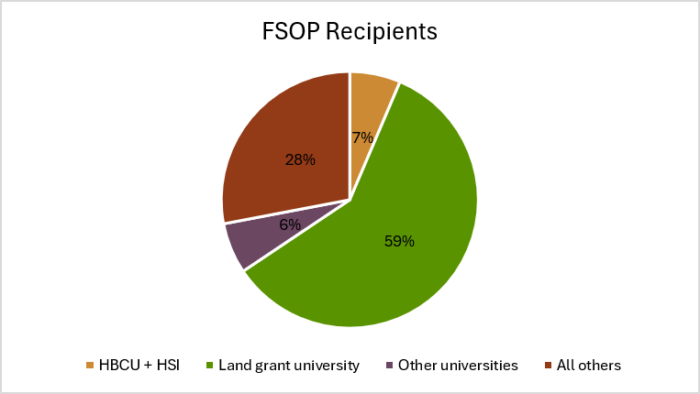
Over the course of the program, as seen in Figure 1, LGUs received the clear majority of grants from this program. While this is not problematic for LGUs to receive funding for this program – LGUs contain many valuable food safety scientists and Extension personnel – their indirect fees and administrative costs can reduce total funding available for programmatic work in outreach and collaborative education projects. The fact that over the history of FSOP, 28% of projects have gone to farming associations, local governments, community associations, and non profits, often working in underserved communities, has been a strength of the program. These awards to these types have a strong history of adaptive education, community trust, and understanding of niche food safety education issues.
Figure 1: Total Historical FSOP Awards
However, there has been a worrying trend in recent years of an increase in only one type of recipient, LGUs, and shrinking award amounts for all other recipient types. In fact, in 2024, no farmer-serving nonprofit organizations received any FSOPs. In 2025, HBCUs and HSIs fared similarly.
Figure 2: Percentage of FSOP awards per year by recipient type
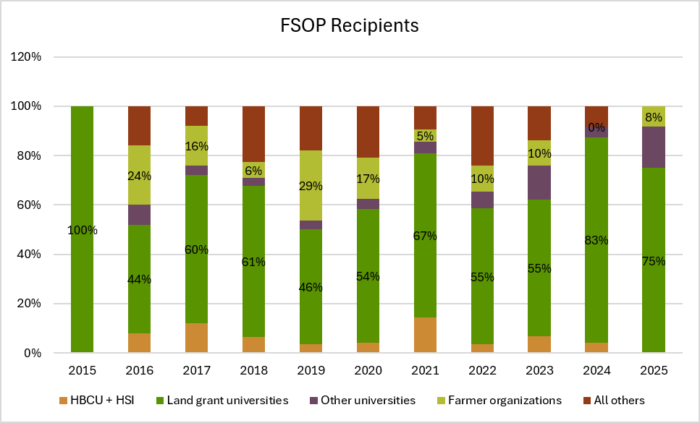
Figure 3: Percentage of FSOP funding by year per recipient type
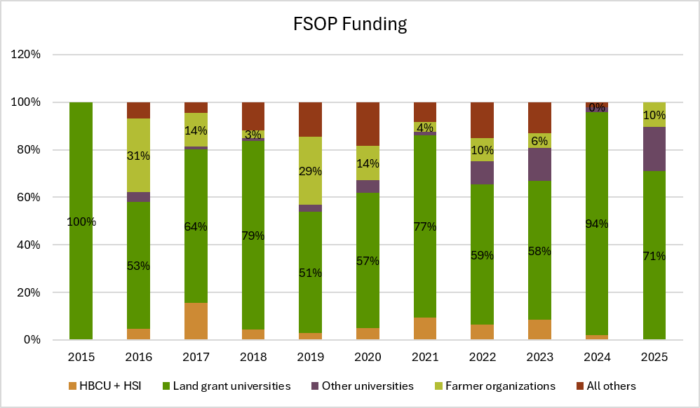
Some of this variation can be accounted for in that FSOP funds the FSMA Regional Centers every three years, but the complete lack of awards for two recipient types over two years, and increasing amounts of awards only to LGUs that FSOP might not be able to fully reach its goal of targeting smaller-scale and economically vulnerable farmers.
Going Forward
Continued analysis, such as analyzing applicant institution types, not just award recipients, will be necessary to better understand why these trends have occurred. NSAC will continue to analyze future years’ program data, push for further internal review of limiting factors for farming association organizations, and full length application windows longer than 30 business days.
This trend also further demonstrates a need for a higher funding authorization level for this program. Given the impacts of inflation and the potential for more project funds to be directed toward administrative costs instead of programming, the outreach and training needed to help support farmers with ongoing FSMA implementation may not reach their intended audience.